


Anacampseros retusa filamentosa - 5.5cm
- Top quality from the succulent master craftsman.
- Hand-picked
- Special feature: Rarity
- Carefully and securely packaged in our special protective packaging.
- Labeled with botanical name.
- With general care instructions from our master gardener.
- Pot size: Ø 6.0cm
- Without a decorative pot
Anacampseros retusa filamentosa - 5.5cm is backordered and will ship as soon as it is back in stock.
Pickup available at Wetzstein 1
Usually ready in 24 hours
1% of every order for nature conservation
1% of every order for nature conservation
🌍 With every order, you help protect plant habitats. We donate 1% of every order to CSSA for the preservation of endangered succulent habitats.
Care instructions for your
Care instructions for your
Display general product information or specific product information using metafields.
Delivery & Shipping
Delivery & Shipping
Your succulent travels safely and protected: Individually packed in our custom plant box, it arrives stress-free and ready to conquer its new home.

Anacampseros retusa filamentosa - 5.5cm
Reviews (0)
Reviews (0)
Your new succulent roommate 🌿
I am
Anacampseros retusa filamentosa – a rare miniature succulent with character
The Anacampseros retusa filamentosa is a small, yet remarkably charming succulent that immediately catches the eye with its dense cushions, fine threads, and pretty flowers. As a special form of the well-known Anacampseros retusa, it is considered a rarity among enthusiasts and is ideal for collectors or anyone who appreciates unusual plants.
Origin and special features
Anacampseros retusa filamentosa is native to the arid regions of South Africa, where it grows on rocky soils and in rock crevices. This environment is characterized by intense sun and very little water, making the plant a true survivor.
Its most striking feature are the fine, white threads that grow between the succulent leaves. These delicate structures give it a special appearance and additionally help to store moisture and protect the plant from excessive sun exposure.
Appearance
- Leaves: Small, thick, green to grey-green, and tightly clustered in cushions.
- Threads: The characteristic delicate threads give the plant its epithet "filamentosa" and are its most important identifying feature.
- Flowers: In spring or summer, it adorns itself with delicate, pink to violet flowers that stand above the foliage and create a pretty contrast.
- Size: Remains very compact, slowly growing into a low cushion (5–10 cm in height).
Care & Location
Caring for Anacampseros retusa filamentosa is uncomplicated, as long as a few basic rules are observed.
Location
A sunny spot is crucial – ideally on a south-facing window or on the balcony during the warm months. The brighter it is, the denser and more intensely colored the plant will grow.
Watering
- Water regularly from spring to autumn, as soon as the substrate has completely dried out.
- Reduce watering significantly in winter – the plant then needs almost no water.
- Absolutely avoid waterlogging, as the roots are sensitive.
Substrate
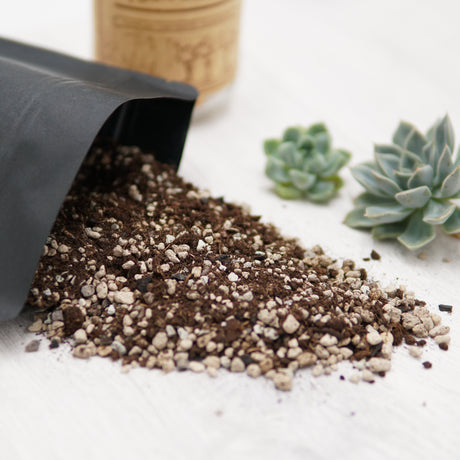
An ideal substrate is mineral, well-draining. Normal cactus soil can be loosened with sand, perlite, or pumice so that excess water can drain away quickly.
Temperature
- In summer: 18–28 °C, even warmer is possible.
- In winter: Cooler conditions at 8–12 °C promote flowering.
- The plant is not frost-hardy.
Fertilization
During the growing season, fertilize about once a month with a weak cactus fertilizer. Do not provide nutrients during winter dormancy.
Propagation
Anacampseros retusa filamentosa can be propagated by leaf or stem cuttings as well as by sowing. Cuttings are the fastest and easiest way to obtain new plants.
Popular uses
Thanks to its compact growth, this succulent is suitable for many applications:
- As a collector's item: Especially popular among connoisseurs due to its fine threads.
- Windowsill plant: Decorative, space-saving, and easy to care for.
- Mini gardens and bowls: Can be excellently combined with other small succulents.
- Gift idea: A special plant that surprises and brings long-lasting joy.
Cultivation tips
- Rotate regularly so that the plant grows evenly.
- Water sparingly – rather dry than too wet.
- Be careful when repotting: The fine threads are delicate.
- Repot into fresh, mineral substrate every 2 years.
FAQ – Frequently Asked Questions
-
How often does the plant need to be watered?
During the growing season every 1–2 weeks, almost never in winter.
-
Why does the plant have threads between its leaves?
These serve as protection from the sun and help retain moisture.
-
How do I get the plant to bloom?
A bright location and a cool winter dormancy are the most important factors.
-
What pot size is suitable?
Small pots or bowls with drainage holes are best.
-
Can I put it outdoors?
Yes, from May to September, but it must be protected from rain.
-
Is the plant poisonous?
It is not considered poisonous, but should not be consumed.
-
What is the easiest way to propagate Anacampseros retusa filamentosa?
By leaf or stem cuttings – quick and uncomplicated.
-
Does the plant grow large?
No, it remains compact and slowly grows into a low cushion.
-
How long does the plant live?
With proper care, it can live for decades.
- Can it be planted with other succulents?
Yes, it harmonizes very well with smaller species in decorative arrangements.
Summary
Anacampseros retusa filamentosa is a true peculiarity among succulents. Its compact growth, fine threads, and beautiful flowers make it a valuable addition to any collection. It is easy to care for, decorative, and long-lasting – perfect for anyone who appreciates the extraordinary in miniature.


Gewährleistung & Deine Rechte
Unsere Pflanzen sind lebende Naturprodukte und kein Industrieartikel. Jede Pflanze ist ein Unikat: Form, Größe, Färbung und Beblätterung können vom Produktfoto abweichen. Das ist kein Mangel, sondern Teil ihres natürlichen Charakters.
Wir prüfen jede Pflanze vor dem Versand und verpacken sie so, dass sie gesund und im perfekten Zustand bei Dir ankommt. Für den Zustand bei Lieferung stehen wir selbstverständlich ein. Sollte Deine Pflanze beschädigt oder erkennbar nicht in Ordnung ankommen, melde Dich einfach innerhalb weniger Tage bei uns und dokumentiere alles mit ein bis zwei Fotos. Wir finden eine Lösung.
Wie sich eine Sukkulente danach entwickelt, hängt von Standort, Gießverhalten und Jahreszeit ab. Kleinere Veränderungen wie das Einziehen unterer Blätter, angepasstes Wachstum oder eine veränderte Färbung sind normale Anzeichen eines lebenden Organismus, der sich an sein neues Zuhause gewöhnt. Damit Deine Pflanze gut anwächst, findest du bei uns ausführliche Pflege- und Standorttipps.
Deine gesetzlichen Rechte bleiben davon unberührt - die Einzelheiten dazu findest Du im Gewährleistungshinweis oben.
