


Tillandsia tectorum Snowball L
- Top quality from the succulent master craftsman.
- Hand-picked
- Special feature: Rarity
- Labeled with botanical name.
- With care tips from our master gardener
- Safely packaged in special protective packaging.
- Pot size: Ø 6.0cm
Tillandsia tectorum Snowball L is backordered and will ship as soon as it is back in stock.
Pickup currently unavailable at Wetzstein 1
Care instructions for your
Care instructions for your
Tillandsias don't need soil; they absorb moisture and nutrients through their leaves. Mist your Tillandsia tectorum Snowball L 2–3 times a week with low-lime water/rainwater or briefly submerge them. They appreciate a bright location with good air circulation.
Care instructions for your air plant
Care instructions for your air plant
Tillandsias don't need soil; they absorb moisture and nutrients through their leaves. Mist your Tillandsia tectorum Snowball L 2–3 times a week with low-lime water/rainwater or briefly submerge them. They appreciate a bright location with good air circulation.
Delivery & Shipping
Delivery & Shipping
We pack each plant with love and care in our specially developed protective packaging. This ensures that your plants arrive healthy and undamaged.
Reviews (2)
Reviews (2)
Your new succulent roommate 🌿
I am
The Tillandsia tectorum 'Snowball' belongs to the bromeliad family and originates from South America, especially Peru. It gets the name 'Snowball' from its appearance, which strongly resembles a snowflake.
Appearance
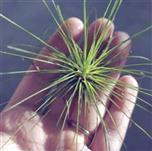
The Tillandsia tectorum 'Snowball' has grey-white leaves. When it blooms, the tillandsia produces purple flowers. It can take several years for the tillandsia to bloom.
Care
The Tillandsia tectorum 'Snowball' needs a bright to sunny location and is not suitable for the garden. Direct midday sun should be avoided. It is best to soak the Tillandsia in rainwater once a week, submerging the entire plant in the water and then allowing it to dry. Make sure that no water ever remains in the leaf rosette and add suitable fertilizer every second time in summer. Another way to water the Tillandsia is to spray it with water several times a week. If no rainwater is available, either let tap water stand in a bowl overnight or mix it with distilled water; this prevents calcification of the Tillandsia. You can tell whether tillandsias are thirsty or not by observing if their leaves curl up when they get too dry.
Name: Tillandsia tectorum 'Snowball' also known as Pourretia nivosa, Tillandsia rupicola, and Tillandsia saxicola.
Family: Bromeliads (Bromeliaceae)
Origin: The Tillandsia tectorum 'Snowball' originally comes from South America, especially Peru.
Appearance
Color: Grey-white leaves arranged in a rosette shape.
Bloom: When in bloom, the tillandsia produces purple flowers.
Size: Ø 5-7cm; Height: 3-5cm
Care
Location: The Tillandsia tectorum 'Snowball' requires a bright to sunny location. It is not suitable for the garden.
Watering: It is best to soak the Tillandsia in rainwater every two weeks and then let it dry, or spray it with water several times a week. Make sure that no water ever remains in the leaves. Substrate: Tillandsias should not be placed in moist soil; mineral substrate, sand, or no substrate is more suitable. Propagation: Tillandsias can be propagated by pollination and seed formation. Since they are not self-fertilizing, pollen must be transferred from another plant of the same species with a fine brush. The formation of pups is the second method of tillandsia propagation. Tillandsias often form pups, i.e., new plants, on the stem of the mother plant. This is especially necessary because the mother plant dies after flowering.
PASIORA Tip: Order our new eBook "Sukkulenten richtig gießen" (Watering Succulents Correctly) now. In 13 detailed chapters, we have summarized all the information on proper care for you.
Note: Our tillandsias all come from greenhouse cultivation and not from wild populations!
Note: Sizes and shapes can vary for plants, where each plant is unique. This is especially true in winter or when availability is low. The coloration also varies depending on the season.

Frequently Asked Questions (FAQ)
Basics
Do Tillandsias need soil?
Do Tillandsias need soil?
No. They absorb water/nutrients through trichomes and are attached, laid or hung. Of course, Tillandsias offered in pots are an exception. For example, Tillandsia cyanea.
How bright should the right location be?
How bright should the right location be?
Bright to very bright, preferably with morning/evening sun. No direct midday sun behind glass (magnifying glass effect).
Grey vs. green Tillandsias – what's the difference?
Grey vs. green Tillandsias – what's the difference?
Grey tillandsias (with many trichomes) tolerate more sun and dryness; green ones prefer humid air and a slightly shadier location.
How can I attach Tillandsia plants?
How can I attach Tillandsia plants?
Tillandsias can be attached to the substrate with solvent-free adhesives. We recommend florist glue or UHU-Polymax. Absolutely avoid hot glue! The high temperatures can damage the tillandsia. Alternatively, (stainless steel) wire is also very suitable.

Gewährleistung & Deine Rechte
Unsere Pflanzen sind lebende Naturprodukte und kein Industrieartikel. Jede Pflanze ist ein Unikat: Form, Größe, Färbung und Beblätterung können vom Produktfoto abweichen. Das ist kein Mangel, sondern Teil ihres natürlichen Charakters.
Wir prüfen jede Pflanze vor dem Versand und verpacken sie so, dass sie gesund und im perfekten Zustand bei Dir ankommt. Für den Zustand bei Lieferung stehen wir selbstverständlich ein. Sollte Deine Pflanze beschädigt oder erkennbar nicht in Ordnung ankommen, melde Dich einfach innerhalb weniger Tage bei uns und dokumentiere alles mit ein bis zwei Fotos. Wir finden eine Lösung.
Wie sich eine Sukkulente danach entwickelt, hängt von Standort, Gießverhalten und Jahreszeit ab. Kleinere Veränderungen wie das Einziehen unterer Blätter, angepasstes Wachstum oder eine veränderte Färbung sind normale Anzeichen eines lebenden Organismus, der sich an sein neues Zuhause gewöhnt. Damit Deine Pflanze gut anwächst, findest du bei uns ausführliche Pflege- und Standorttipps.
Deine gesetzlichen Rechte bleiben davon unberührt - die Einzelheiten dazu findest Du im Gewährleistungshinweis oben.
