

Ceropegia woodii f. variegata - 6cm
- Top quality from the succulent master craftsman.
- Hand-picked
- Special feature: Rarity
- Carefully and securely packaged in our special protective packaging.
- Labeled with the botanical name.
- With general care instructions from our master gardener.
- Pot size: Ø 6.0cm
- Without a decorative outer pot.
Ceropegia woodii f. variegata - 6cm is backordered and will ship as soon as it is back in stock.
Pickup currently unavailable at Wetzstein 1
Care instructions for your
Care instructions for your
Succulents store water in their leaves and therefore tolerate drought well. Place them in a bright, sunny spot and only water them when the soil is completely dry. Avoid waterlogging at all costs!
It's better to water a little too little than too much.
Care instructions for your
Care instructions for your
Succulents store water in their leaves and therefore tolerate drought well. Place them in a bright, sunny spot and only water when the soil is completely dry. Avoid waterlogging at all costs!
It's better to water a little too little than too much.
Delivery & Shipping
Delivery & Shipping
We pack each plant with love and care in our specially developed protective packaging. This ensures that your plants arrive healthy and undamaged.
🌿 Profile & Origin
🌿 Profile & Origin
Here you will find the most important information about your :
Genus:
Origin:
Your new succulent roommate 🌿
I am
Ceropegia woodii f. variegata – the elegant String of Hearts with variegation
Ceropegia woodii f. variegata, better known as the variegated String of Hearts, is an even more exclusive version of the popular Ceropegia woodii. Its heart-shaped leaves are not only characterized by the typical silvery markings, but are also adorned with cream, pink, and sometimes even almost white variegation. These delicate plays of color make it a true ornamental plant for any home.
However, variegation not only offers aesthetic benefits: it also directly affects care – and requires a little more attention than the green basic form.
Origin and Special Features
Like its "classic sister," Ceropegia woodii f. variegata originates from the dry regions of South Africa. There, it grows climbing or hanging over rocky surfaces and shrubs in nature. Thanks to small storage tubers along its shoots, it is optimally adapted to longer dry periods.
The special characteristic of the Variegata form is the reduced amount of green chlorophyll in the leaves. This makes them appear partially light or pink – which makes them unique, but at the same time also more light-sensitive and more susceptible to care errors.
Appearance
- Leaves: Heart-shaped with fine marbling, additionally with cream to pink sections. This variegation makes each plant unique.
- Stems: Fine, often several meters long vines that elegantly droop over the edge of the pot.
- Flowers: Tubular, violet to purple with a dark tip – a subtle but pretty contrast to the leaves.
- Tubers: Small thickenings on the stems that store water and facilitate propagation.
Care Instructions
Location
The Variegata needs even more light than the green form, as the light parts of the leaves contain less chlorophyll and therefore perform less photosynthesis. A bright spot directly by the window (south or west-facing window) is optimal. If there is insufficient light, the leaves lose their variegation and become greener.
Watering
- During the growing season (spring to autumn), water regularly, but always only when the substrate has completely dried out.
- In winter, water rarely and very sparingly – approximately every 3–4 weeks.
- Absolutely avoid waterlogging, as the plant reacts sensitively to too much water.
Substrate
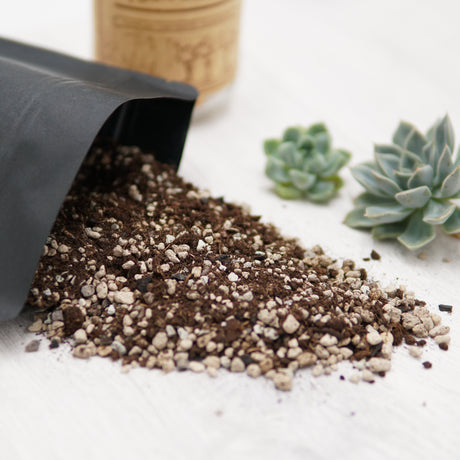
A very well-draining, mineral-enriched substrate is essential. A mixture of cactus soil, sand, pumice, and perlite is best.
Temperature
- Summer: 18–28 °C, also happy outdoors in a sheltered spot.
- Winter: 12–15 °C for a slight rest period.
Fertilization
From spring to autumn, fertilize every 4–6 weeks with a mild, potassium-rich succulent fertilizer. No fertilizer in winter.
Propagation
- Cuttings: Easiest via stem cuttings with 2–3 leaves, which are rooted in water or soil.
- Tubers: The small tubers on the stems can be carefully separated and placed in new substrate.
Possible Uses
Ceropegia woodii f. variegata is a versatile decorative plant that looks particularly beautiful in hanging baskets, containers, or draped over shelf edges due to its delicate vines. Its colorful foliage adds stylish accents – whether in modern minimalism, boho style, or as a romantic detail in classic interiors.
Tips and Tricks
- Light is crucial: Only with sufficient brightness will the variegation remain stable and intense.
- Denser growth: Shortening long shoots promotes branching. Replant cuttings immediately to make the pot appear fuller.
- Don't forget winter dormancy: A cooler and drier phase in winter promotes vitality and flowering.
Frequently Asked Questions
1. Why is my Ceropegia woodii f. variegata losing its variegation?
Lack of light is usually the cause – move it to a brighter spot, ideally directly by the window.
2. Is the Variegata more delicate than the normal form?
Yes, it requires more light and grows a little slower.
3. How often do I need to water?
Only when the soil is completely dry. Approximately every 1–2 weeks in summer, even less often in winter.
4. Can it be placed outdoors in summer?
Yes, as long as it is protected from direct midday sun and rain.
5. Is it toxic?
It is considered non-toxic and is therefore suitable for households with children or pets.
6. How do I get the plant to flower?
A bright location, sparse winter care, and temperatures of around 12–15 °C during the dormant period promote flowering.
7. How fast does the Variegata grow?
Slower than the green form, as the variegation allows for less photosynthesis.
8. What pot size is ideal?
Slightly larger than the root ball, always with a drainage hole. Shallow pots show off the vines particularly well.
9. How long does the plant live?
Many years with good care – you can constantly renew its stock through propagation.
10. Can I plant it with other succulents?
Yes, as long as similar care conditions prevail. It looks particularly decorative with Echeverias or smaller Haworthias.
Conclusion
Ceropegia woodii f. variegata is the elegant sister of the classic String of Hearts – noble, charming, and a little more demanding. Its colorful leaves and delicate vines are a highlight for any plant collection. With plenty of light, sparse watering, and a little patience, it will develop into a long-lasting, decorative companion that enriches living spaces with lightness and color.
Blog: You can find an article about Ceropegia woodii here.
Matching Ø6cm cache pots
View allThis is how you give your plants even more character.
These pots are a perfect complement to your
-
 Sold out
NIMAH cachepot for 6cm succulents
Regular price 5,40 €Unit price -
Sold out
-
-
 Sold out
 -
 Sold out
 -
 Sold out
Decorative pot SPRINKLE PARTY for 6cm succulents
Regular price 5,40 €Unit price -
Sold out
Gold decorative pot for 6cm succulents
Regular price 3,50 €Unit price -
-
Sold out
-
-
 Sold out
Tulip Pink Planter for 6cm Succulents
Regular price 3,80 €Unit price




Gewährleistung & Deine Rechte
Unsere Pflanzen sind lebende Naturprodukte und kein Industrieartikel. Jede Pflanze ist ein Unikat: Form, Größe, Färbung und Beblätterung können vom Produktfoto abweichen. Das ist kein Mangel, sondern Teil ihres natürlichen Charakters.
Wir prüfen jede Pflanze vor dem Versand und verpacken sie so, dass sie gesund und im perfekten Zustand bei Dir ankommt. Für den Zustand bei Lieferung stehen wir selbstverständlich ein. Sollte Deine Pflanze beschädigt oder erkennbar nicht in Ordnung ankommen, melde Dich einfach innerhalb weniger Tage bei uns und dokumentiere alles mit ein bis zwei Fotos. Wir finden eine Lösung.
Wie sich eine Sukkulente danach entwickelt, hängt von Standort, Gießverhalten und Jahreszeit ab. Kleinere Veränderungen wie das Einziehen unterer Blätter, angepasstes Wachstum oder eine veränderte Färbung sind normale Anzeichen eines lebenden Organismus, der sich an sein neues Zuhause gewöhnt. Damit Deine Pflanze gut anwächst, findest du bei uns ausführliche Pflege- und Standorttipps.
Deine gesetzlichen Rechte bleiben davon unberührt - die Einzelheiten dazu findest Du im Gewährleistungshinweis oben.
