Othonna capensis Ruby Necklace - 6cm
- Top quality from the succulent master craftsman.
- Hand-picked
- Special feature: Rarity
- Carefully and securely packaged in our special protective packaging.
- Labeled with the botanical name.
- With general care instructions from our master gardener.
- Pot size: Ø 6.0cm
- Without a decorative outer pot.
Othonna capensis Ruby Necklace - 6cm is backordered and will ship as soon as it is back in stock.
Pickup currently unavailable at Wetzstein 1
Care instructions for your
Care instructions for your
Succulents store water in their leaves and therefore tolerate drought well. Place them in a bright, sunny spot and only water them when the soil is completely dry. Avoid waterlogging at all costs!
It's better to water a little too little than too much.
Care instructions for your
Care instructions for your
Succulents store water in their leaves and therefore tolerate drought well. Place them in a bright, sunny spot and only water when the soil is completely dry. Avoid waterlogging at all costs!
It's better to water a little too little than too much.
Delivery & Shipping
Delivery & Shipping
We pack each plant with love and care in our specially developed protective packaging. This ensures that your plants arrive healthy and undamaged.
Reviews (0)
Reviews (0)
🌿 Profile & Origin
🌿 Profile & Origin
Here you will find the most important information about your :
Genus:
Origin:
Your new succulent roommate 🌿
I am
Othonna capensis Ruby Necklace – the colorful trailing succulent
The Othonna capensis Ruby Necklace, also known as "Ruby Necklace Plant," is an extraordinary succulent that captivates with its brightly colored stems and decorative appearance. With its contrasting colors and uncomplicated care, it is suitable for both beginners and experienced plant enthusiasts. Especially in hanging baskets, it fully unfolds its beauty and brings a touch of exoticism to any room.
Origin and History
The Othonna capensis belongs to the daisy family (Asteraceae) and is native to South Africa. There, it grows in rocky, dry regions and has adapted excellently to fluctuating temperatures and longer dry periods. The 'Ruby Necklace' variety owes its name to the intense colors of its stems and leaves, which resemble a luminous necklace and enrich any collection.
Appearance of Othonna capensis Ruby Necklace
The plant impresses with its trailing, reddish-purple stems, which can grow up to 60 cm long. On them are narrow, succulent leaves in shades of green to purple, which turn a more intense violet or ruby red in strong light.
- Leaves: narrow, slightly curved, succulent, with a smooth surface.
- Stems: long, trailing, colored from green to red to intense purple.
- Flowers: In contrast to the extravagant foliage, the flowers are small, bright yellow and resemble small daisies. They appear mainly in spring and summer and provide a cheerful contrast to the dark foliage.
Care Requirements
Location
The Ruby Necklace loves bright, sunny spots. A location at a south or west-facing window is ideal. In summer, it can also be placed outdoors, but should be protected from heavy rain there. The more light it receives, the more intense its ruby red hues will be.
Watering
Like many succulents, Othonna stores water in its leaves. Therefore, the substrate should dry out completely between waterings. In summer, water every 1–2 weeks, and very sparingly in winter during its dormant phase. Absolutely avoid waterlogging.
Substrate
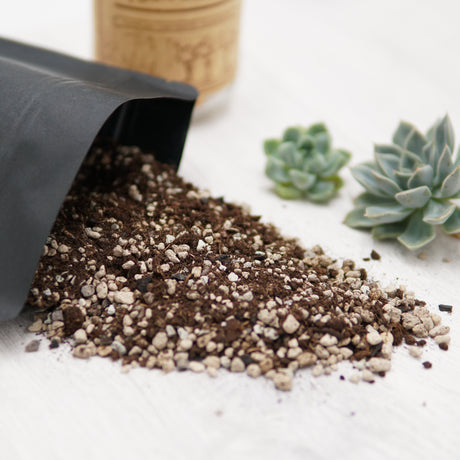
A well-draining substrate such as succulent soil mixed with perlite, sand, or lava grit is best. Good drainage in the pot is important to quickly drain excess water.
Temperature
Othonna capensis thrives best at temperatures between 18 and 25 °C. In winter, it prefers a cooler phase at about 10–12 °C. It is not frost-hardy, so it should be brought indoors in time.
Fertilization
From spring to autumn, the plant can be fertilized every 3–4 weeks with a succulent fertilizer. No fertilization is necessary during winter dormancy.
Propagation
Propagating the Ruby Necklace is straightforward and easily achieved via cuttings. Individual stems are cut, left to dry for a few days, and then placed in fresh, well-draining substrate. Within a few weeks, roots will form, and new plants will emerge.
Possible Uses
The Othonna capensis Ruby Necklace is perfect as a decorative hanging plant or for creative plant arrangements:
- Hanging Baskets and Shelves: Its long, colorful stems look best when allowed to trail.
- Combinations: It adds colorful accents in succulent arrangements or mini-gardens.
- Indoor and Outdoor Areas: Ideal as an eye-catcher in bright living rooms or on balconies and terraces in summer.
Tips and Tricks
- Intensify colors: Lots of light promotes vibrant ruby and purple tones.
- Prune regularly: Stems can be shortened to keep the plant more compact and bushy.
- Pest control: Mealybugs can occasionally appear – regular checks prevent problems.
Answers to the 10 Most Common Questions about Othonna capensis Ruby Necklace
-
How often should you water the Ruby Necklace?
Approximately every 1–2 weeks in summer, only sparingly in winter.
-
Why does the plant lose its red coloration?
Usually due to insufficient light – moving it to a brighter spot promotes intense coloration.
-
Can it be placed outdoors?
Yes, in summer in a sheltered location without constant rain.
-
Is the plant poisonous?
Not poisonous to humans, but it should be kept away from pets.
-
How often does it need repotting?
Approximately every 2–3 years into fresh substrate.
-
How long do the stems grow?
Up to 60 cm, and more under optimal conditions.
-
Can the plant be made bushier?
Yes, by regular pruning and propagation from cuttings.
-
When does the Ruby Necklace bloom?
Mainly in spring and summer with small yellow flowers.
-
What is the ideal substrate?
Well-draining succulent or cactus soil, mixed with perlite or sand.
- How long does the plant live?
Many years with good care; it can always be rejuvenated through cuttings.
Blog: You can find an article about Othanna capensis 'Ruby Necklace' here .
Matching Ø6cm cache pots
View allThis is how you give your plants even more character.
These pots are a perfect complement to your