

Tylecodon buchholzianus - 8.5cm
- Top quality from the succulent master craftsman.
- Hand-picked
- Special feature: Rarity
- Carefully and securely packaged in our special protective packaging.
- Labeled with the botanical name.
- With general care instructions from our master gardener.
- Pot size: Ø 6.0cm
- Without a decorative pot
Tylecodon buchholzianus - 8.5cm is backordered and will ship as soon as it is back in stock.
Pickup currently unavailable at Wetzstein 1
Care instructions for your
Care instructions for your
Succulents store water in their leaves and therefore tolerate drought well. Place them in a bright, sunny spot and only water when the soil is completely dry. Avoid waterlogging at all costs!
It's better to water a little too little than too much.
Care instructions for your
Care instructions for your
Succulents store water in their leaves and therefore tolerate drought well. Place them in a bright, sunny spot and only water when the soil is completely dry. Avoid waterlogging at all costs!
It's better to water a little too little than too much.
Delivery & Shipping
Delivery & Shipping
We pack each plant with love and care in our specially developed protective packaging. This ensures that your plants arrive healthy and undamaged.
Reviews (0)
Reviews (0)
🌿 Profile & Origin
🌿 Profile & Origin
Here you will find the most important information about your :
Genus:
Origin:
Your new succulent roommate 🌿
I am
Tylecodon buchholzianus – an exceptional succulent with character
The Tylecodon buchholzianus is a true rarity among succulents. With its bizarre growth form and special adaptations to extreme habitats, it immediately attracts attention. Collectors and lovers of unusual plants, in particular, value it as a fascinating piece of living nature.
Origin and distribution
This succulent belongs to the Crassulaceae family and originates from the barren regions of Namibia and South Africa. There, it grows on rocky slopes and in mineral, dry soils. The combination of hot summers and rainier winters has shaped the species into a resilient plant, perfectly adapted to extreme climatic conditions.
Appearance
The appearance of Tylecodon buchholzianus looks almost like a small sculpture:
- Stem: Older specimens develop a thickened, gnarled trunk with fissured bark, which serves as a water reservoir.
- Shoots: Irregularly branched stems give the plant its striking, almost surreal silhouette.
- Leaves: In winter, small, fleshy leaves sprout in shades of green to gray. At the onset of summer, they are shed to reduce water loss.
- Flowers: The tubular flowers appear on long inflorescences and are usually yellowish to green in color. Despite their simplicity, they lend the plant a subtle elegance.
Care and cultivation
Although it appears exotic, Tylecodon buchholzianus is not complicated to maintain. It is important to know its specific growth phases.
Location
The plant thrives best in a sunny spot, for example, on a bright windowsill with a south or west orientation. In summer, it can also be placed outdoors – protected from continuous rain and harsh midday sun.
Watering
As it is a winter grower, it is watered regularly but moderately during the colder season. The substrate should dry out, but not completely. During summer dormancy, it is sufficient to water the plant sparingly at most once a month.
Substrate
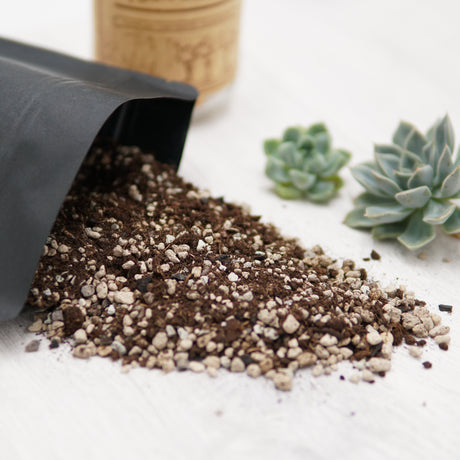
Optimal is a very permeable soil, rich in mineral components such as pumice, lava, or sand. Pure cactus or succulent soil can be improved with such additives. A pot with a drainage hole is important to prevent waterlogging.
Temperature
During the active growing season, the plant prefers temperatures between 15 and 25 °C. In the summer months, it can tolerate heat, but should then be slightly shaded. Cold temperatures below 10 °C must be avoided, as it is not frost-tolerant.
Fertilization
Between autumn and spring, a dose of potassium-rich succulent fertilizer is recommended every 4–6 weeks. During the dormancy period, no fertilization is applied.
Propagation
There are two common methods:
- Cuttings: A healthy shoot is cut, dried for a few days, and then placed in mineral substrate. New roots develop after a short time.
- Seeds: Sowing is possible but requires patience and perseverance. It is particularly suitable for experienced growers.
Use
The Tylecodon buchholzianus is often used as a living art object due to its unique growth. It fits perfectly into modern, minimalist interiors and is also suitable for:
- Special collections of succulents
- decorative terrariums with mineral structure
- windowsills or balconies with plenty of sun and good air circulation
Tips for successful cultivation
- Absolutely avoid waterlogging: Only use permeable substrate and allow excess water to drain.
- Respect the dormancy phase: In summer, the water requirement drastically reduces.
- Regular inspection: Mealybugs and spider mites can occur – early action prevents damage.
The 10 most frequently asked questions about Tylecodon buchholzianus
-
How often do you need to water it?
Every 2–3 weeks in winter; in summer, minimal watering once a month is sufficient.
-
Can it grow outdoors?
Yes, if temperatures are consistently above 10 °C and it is not exposed to rain.
-
What pot size is recommended?
The pot should be slightly larger than the root ball and have a drainage hole.
-
Why does it lose its leaves?
This is a normal process during summer dormancy.
-
How does its typical shape develop?
Through plenty of light, sparse watering, and a mineral substrate.
-
Is the plant poisonous?
Yes, it is considered poisonous and should not be within reach of children or pets.
-
Which pests are typical?
Mainly mealybugs and spider mites.
-
What is the easiest way to propagate it?
Through cuttings – this method is straightforward and reliable.
-
Does it need a dormant period?
Yes, it enters a dormant phase in summer and requires almost no water.
- How old can it get?
With good care, several decades.
Conclusion
The Tylecodon buchholzianus is not only an easy-to-care-for succulent but also a living work of art. With its unusual silhouette, seasonal leaf changes, and decorative flowers, it offers both beginners and experienced collectors an exciting cultivation experience. Those who care for it correctly can enjoy this special plant for many years.
Matching Ø8.5cm cache pots
View allThis is how you give your plants even more character.
These pots are a perfect complement to your
-
Sold out
SUNNY cachepot for 8.5cm succulents
Regular price 16,30 €Unit price -
-
 Sold out
Kopf small planter for 8.5cm succulents
Regular price 17,30 €Unit price



Gewährleistung & Deine Rechte
Unsere Pflanzen sind lebende Naturprodukte und kein Industrieartikel. Jede Pflanze ist ein Unikat: Form, Größe, Färbung und Beblätterung können vom Produktfoto abweichen. Das ist kein Mangel, sondern Teil ihres natürlichen Charakters.
Wir prüfen jede Pflanze vor dem Versand und verpacken sie so, dass sie gesund und im perfekten Zustand bei Dir ankommt. Für den Zustand bei Lieferung stehen wir selbstverständlich ein. Sollte Deine Pflanze beschädigt oder erkennbar nicht in Ordnung ankommen, melde Dich einfach innerhalb weniger Tage bei uns und dokumentiere alles mit ein bis zwei Fotos. Wir finden eine Lösung.
Wie sich eine Sukkulente danach entwickelt, hängt von Standort, Gießverhalten und Jahreszeit ab. Kleinere Veränderungen wie das Einziehen unterer Blätter, angepasstes Wachstum oder eine veränderte Färbung sind normale Anzeichen eines lebenden Organismus, der sich an sein neues Zuhause gewöhnt. Damit Deine Pflanze gut anwächst, findest du bei uns ausführliche Pflege- und Standorttipps.
Deine gesetzlichen Rechte bleiben davon unberührt - die Einzelheiten dazu findest Du im Gewährleistungshinweis oben.
