

Phyllanthus Myrabillis - 17cm in a terracotta pot
- Top quality from the succulent master craftsman.
- Hand-picked
- Special feature: Rarity
- Carefully and securely packaged in our special protective packaging.
- Labeled with botanical name.
- With general care instructions from our master gardener.
- Pot size: Ø 6.0cm
- Without a decorative pot
Phyllanthus Myrabillis - 17cm in a terracotta pot is backordered and will ship as soon as it is back in stock.
Pickup currently unavailable at Wetzstein 1
Care instructions for your
Care instructions for your
Succulents store water in their leaves and therefore tolerate drought well. Place them in a bright, sunny spot and only water them when the soil is completely dry. Avoid waterlogging at all costs!
It's better to water a little too little than too much.
Care instructions for your
Care instructions for your
Succulents store water in their leaves and therefore tolerate drought well. Place them in a bright, sunny spot and only water when the soil is completely dry. Avoid waterlogging at all costs!
It's better to water a little too little than too much.
Delivery & Shipping
Delivery & Shipping
We pack each plant with love and care in our specially developed protective packaging. This ensures that your plants arrive healthy and undamaged.
Reviews (0)
Reviews (0)
🌿 Profile & Origin
🌿 Profile & Origin
Here you will find the most important information about your :
Genus:
Origin:
Your new succulent roommate 🌿
I am
Phyllanthus mirabilis – the elegant caudex with leaf movements
The Phyllanthus mirabilis is a true rarity among houseplants. It fascinates not only with its decorative caudex – a tuber-like thickening that stores water and nutrients – but also with its extraordinary behavior: its large, feathered leaves close in the evening and open again in the morning. This diurnal “sleep movement” makes it a lively eye-catcher in any plant collection.
Origin and special features
The Phyllanthus mirabilis belongs to the spurge family (Phyllanthaceae) and is originally from the dry regions of Thailand, Laos, and Myanmar. There, it grows in sandy-stony soils and survives longer dry periods thanks to its mighty caudex.
Its special feature lies not only in its robust survival organ but primarily in the dynamics of its leaves: During the day, it displays magnificent, lush green foliage, while the leaflets gently fold together at sunset – a natural protective mechanism that minimizes water loss and clearly distinguishes it from other houseplants.
Appearance
- Caudex: Thickened, woody tuber that gives the plant a sculptural character.
- Leaves: Large, feathered leaves with fresh green, which move and show their rhythm daily.
- Growth habit: The plant forms strong, upright shoots from the caudex, which can branch over time.
- Flowers: Inconspicuous and small, but overshadowed by the attractive leaf movements.
Care instructions
Despite its exotic nature, Phyllanthus mirabilis is surprisingly easy to care for, as long as its natural cycles are respected.
Location
A bright spot with plenty of indirect light is ideal. It tolerates direct sun in moderation, especially in the morning or late afternoon. A south-facing window with light shading or a bright conservatory are perfectly suitable.
Substrate
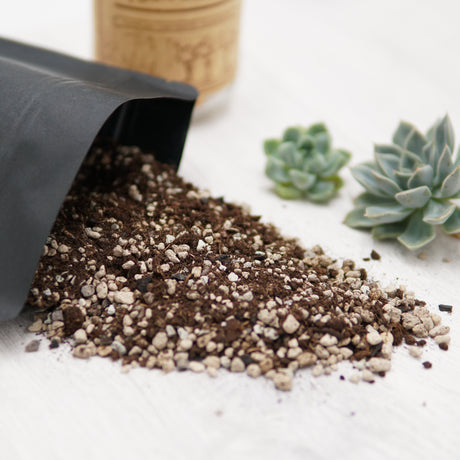
Well-draining, mineral soil is a must. A mixture of cactus soil, pumice, or lava grit prevents waterlogging and supports root health.
Watering
During the growing season in spring and summer, water regularly once the top layer of substrate has dried out. The caudex stores water, so it's better to water a little less than too much.
Dormancy
In autumn, the plant sheds its leaves and retreats into the caudex. During this time, water sparingly, do not fertilize, and keep it cooler (approx. 15 °C). In spring, when the days get longer, it will start to sprout again.
Fertilization
During the active growth phase, fertilize approximately every 3–4 weeks with a mild cactus fertilizer.
Propagation
Phyllanthus mirabilis can be propagated both by seeds and cuttings. Sowing requires patience, while cuttings from younger shoots root relatively reliably at warm temperatures.
Special tips
- Leaf drop is normal: In autumn, the plant appears almost "dead," but this is part of its cycle. Patience pays off!
- Highlight its form: A decorative pot emphasizes the sculptural caudex.
- Don't over-care: Less water is often more – the caudex handles the storage.
Frequently asked questions
1. Why do the leaves of Phyllanthus mirabilis close in the evening?
This is a natural protective mechanism against evaporation – completely normal and fascinating to observe.
2. Is the plant poisonous?
There are no indications of strong toxicity, but it should still be kept out of reach of children and pets.
3. Do I need to keep the plant in the dark in winter?
No, a bright location is also possible – the key is that it's kept cool and almost dry.
4. How big can Phyllanthus mirabilis get?
The caudex can become impressively thick over the years, while the shoots can reach a height of up to 60–80 cm.
5. How often does it bloom?
The flowers are small and inconspicuous; the main attraction remains its foliage and its movement.
6. How fast does Phyllanthus mirabilis grow?
Growth is rather moderate. After sprouting in spring, it develops new leaves within a few weeks, but the caudex itself only thickens slowly over many years.
7. Which pot is best?
Flat, wide pots with drainage holes are best. This prevents waterlogging, and the caudex can be decoratively displayed.
8. Why are no new leaves sprouting, even though it's spring?
This can be due to too cool temperatures, too little light, or watering too early. Place the plant in a warmer, brighter spot and water it cautiously until the first shoots appear.
9. Can I keep Phyllanthus mirabilis outdoors?
In summer, an outdoor spot is possible, as long as temperatures are consistently above 15 °C. However, direct midday sun and rain should be avoided.
10. How long does the plant live?
With proper care, Phyllanthus mirabilis can live for several decades and develop into an impressive collector's item over the years.
Summary
Phyllanthus mirabilis is an extraordinary houseplant for anyone looking for more than just green decor. With its striking caudex, leaves that open and close daily, and its seasonal rhythm, it combines exoticism and vibrancy. Those who respect its dormant period and have patience will be rewarded with a long-lived, fascinating plant that provides conversation material in every season.



Gewährleistung & Deine Rechte
Unsere Pflanzen sind lebende Naturprodukte und kein Industrieartikel. Jede Pflanze ist ein Unikat: Form, Größe, Färbung und Beblätterung können vom Produktfoto abweichen. Das ist kein Mangel, sondern Teil ihres natürlichen Charakters.
Wir prüfen jede Pflanze vor dem Versand und verpacken sie so, dass sie gesund und im perfekten Zustand bei Dir ankommt. Für den Zustand bei Lieferung stehen wir selbstverständlich ein. Sollte Deine Pflanze beschädigt oder erkennbar nicht in Ordnung ankommen, melde Dich einfach innerhalb weniger Tage bei uns und dokumentiere alles mit ein bis zwei Fotos. Wir finden eine Lösung.
Wie sich eine Sukkulente danach entwickelt, hängt von Standort, Gießverhalten und Jahreszeit ab. Kleinere Veränderungen wie das Einziehen unterer Blätter, angepasstes Wachstum oder eine veränderte Färbung sind normale Anzeichen eines lebenden Organismus, der sich an sein neues Zuhause gewöhnt. Damit Deine Pflanze gut anwächst, findest du bei uns ausführliche Pflege- und Standorttipps.
Deine gesetzlichen Rechte bleiben davon unberührt - die Einzelheiten dazu findest Du im Gewährleistungshinweis oben.
