


Stephania nova - 15cm in terracotta pot
- Top quality from the succulent master craftsman.
- Hand-picked
- Special feature: Rarity
- Carefully and securely packaged in our special protective packaging.
- Labeled with botanical name.
- With general care instructions from our master gardener.
- Pot size: Ø 6.0cm
- Without a decorative pot
Stephania nova - 15cm in terracotta pot is backordered and will ship as soon as it is back in stock.
Pickup currently unavailable at Wetzstein 1
Care instructions for your
Care instructions for your
Succulents store water in their leaves and therefore tolerate drought well. Place them in a bright, sunny spot and only water them when the soil is completely dry. Avoid waterlogging at all costs!
It's better to water a little too little than too much.
Care instructions for your
Care instructions for your
Succulents store water in their leaves and therefore tolerate drought well. Place them in a bright, sunny spot and only water when the soil is completely dry. Avoid waterlogging at all costs!
It's better to water a little too little than too much.
Delivery & Shipping
Delivery & Shipping
We pack each plant with love and care in our specially developed protective packaging. This ensures that your plants arrive healthy and undamaged.
Reviews (0)
Reviews (0)
🌿 Profile & Origin
🌿 Profile & Origin
Here you will find the most important information about your :
Genus:
Origin:
Your new succulent roommate 🌿
I am
Stephania nova – an exotic rarity with a decorative caudex
Stephania nova is one of the most fascinating plants for lovers of unusual succulents and rarities. Its distinctive caudex (thickened storage stem) and delicate, heart-shaped leaves make it a real eye-catcher. Due to its unusual appearance and relatively uncomplicated care, it is very popular with both collectors and beginners.
Origin and Classification
Stephania nova originates from the tropical and subtropical regions of Asia, especially Thailand, Laos and adjacent areas. There, it grows in rocky, well-drained soils and has learned to adapt to changing climatic conditions with long dry periods and short rainy seasons.
- Family: Menispermaceae (Moonseed family)
- Growth habit: Caudex plant with climbing shoots
- Special feature: Heart-shaped, delicate leaves that float on thin stalks above the caudex
Its spherical caudex serves as a water reservoir, allowing it to survive long dry periods – a typical strategy of many succulent plants.
Appearance
Stephania nova impresses with its contrasting appearance:
- Caudex: Round to oval, brown-grey in color and often with a textured surface. The older the plant, the more characterful it appears.
- Leaves: Delicate green, roundish to heart-shaped, with fine venation. They grow on long, thin stalks that stand elegantly above the caudex.
- Shoots: Twining and climbing – with the right support, it can grow decoratively upwards.
- Flowers: They rarely appear in cultivation; they are small, inconspicuous inflorescences.
Visually, the plant almost looks like a living sculpture – minimalist, but at the same time full of details.
Location & Care
Despite its exotic appearance, Stephania nova is quite easy to care for if you follow a few basic rules.
Light
It prefers bright, indirect light. Direct midday sun can burn its delicate leaves, while too little light causes slow or weak growth. A bright spot on an east or west-facing window is ideal.
Temperature
- Ideal temperature: 18–28 °C
- Not below 15 °C in winter
- No frost tolerance – therefore only suitable as a houseplant in Central Europe.
Watering
The caudex stores a lot of water, so less is more.
- During the growing season (spring to autumn): water regularly as soon as the top layer of soil has dried out.
- In winter: water significantly less, the caudex can be almost completely dry.
- Avoid waterlogging at all costs, as the plant is very sensitive to wet roots.
Substrate
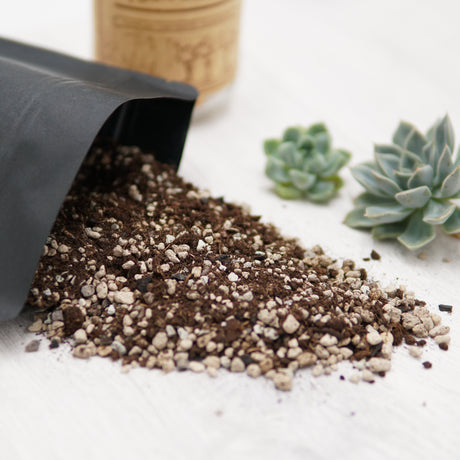
A mineral, loose substrate is best.
- Purely mineral, e.g. in lava or pumice
- Or a mixture: cactus soil + pumice, perlite or sand.
- Important: A pot with a drainage hole so that excess water can drain away.
Fertilization
During the growing season, fertilize every 4 weeks with a diluted cactus fertilizer. Do not add nutrients during the dormant phase in winter.
Dormancy
A special feature of Stephania nova is its winter dormancy:
- In autumn, the plant retracts its leaves and looks like a "dead stone".
- During this phase, almost no watering is done.
- From spring, new leaves sprout – an impressive new beginning every year.
Propagation
Stephania nova can be propagated from both seeds and cuttings.
- Seeds: Germination often takes several weeks, requires warmth and constant humidity.
- Cuttings: Less common in cultivation, but possible from tip cuttings of young shoots.
Since the plant is relatively rare, it is mainly offered as a young plant or already with a caudex in trade.
Use
Stephania nova is not just a plant, but a decorative object.
- Home & Office: A highlight as table decoration or on the windowsill.
- Collection: Popular in caudex and rarity collections.
- Design element: Its minimalist look fits perfectly with modern, Scandinavian or Japanese interior styles.
Tips for healthy plants
- Patience: New leaves often appear late in spring.
- Do not overwater: The caudex should be allowed to dry out completely between waterings.
- Provide support: Climbing shoots can be guided on a bamboo stick or wire ring.
- Repotting: Only necessary every few years, as the plant grows slowly.
FAQ – Frequently Asked Questions
-
Why does my Stephania nova lose its leaves?
This is normal – it goes into winter dormancy and sprouts new leaves in spring.
-
How large does the caudex get?
Depending on its age, it can reach a diameter of a few centimeters to over 20 cm.
-
Can Stephania nova be placed outdoors?
Yes, in summer in a sheltered, semi-shady spot – but without direct midday sun.
-
How often do I need to water it?
In summer about every 1–2 weeks, in winter very sparingly.
-
Does the plant need a climbing aid?
Not strictly necessary, but recommended – the shoots naturally grow as climbers.
-
Can the plant be kept in hydroponics?
No, as the caudex is sensitive to waterlogging.
-
Is the plant poisonous?
Little is known about possible toxicity. As a precaution, keep out of reach of children and pets.
-
How do I get it to flower?
Flowers are rare in cultivation. A bright location and observing the dormancy period are more important.
-
When is the best time to repot?
In spring, when new shoots begin.
- How long does Stephania nova live?
With proper care, it can live for many years, even decades.
Summary
Stephania nova is far more than a houseplant – it is a living work of art. With its round caudex, delicate tendrils and heart-shaped leaves, it combines exotic beauty with astonishing robustness. Those looking for a special succulent that is both easy to care for and exceptionally decorative will enjoy Stephania nova for a long time.


Gewährleistung & Deine Rechte
Unsere Pflanzen sind lebende Naturprodukte und kein Industrieartikel. Jede Pflanze ist ein Unikat: Form, Größe, Färbung und Beblätterung können vom Produktfoto abweichen. Das ist kein Mangel, sondern Teil ihres natürlichen Charakters.
Wir prüfen jede Pflanze vor dem Versand und verpacken sie so, dass sie gesund und im perfekten Zustand bei Dir ankommt. Für den Zustand bei Lieferung stehen wir selbstverständlich ein. Sollte Deine Pflanze beschädigt oder erkennbar nicht in Ordnung ankommen, melde Dich einfach innerhalb weniger Tage bei uns und dokumentiere alles mit ein bis zwei Fotos. Wir finden eine Lösung.
Wie sich eine Sukkulente danach entwickelt, hängt von Standort, Gießverhalten und Jahreszeit ab. Kleinere Veränderungen wie das Einziehen unterer Blätter, angepasstes Wachstum oder eine veränderte Färbung sind normale Anzeichen eines lebenden Organismus, der sich an sein neues Zuhause gewöhnt. Damit Deine Pflanze gut anwächst, findest du bei uns ausführliche Pflege- und Standorttipps.
Deine gesetzlichen Rechte bleiben davon unberührt - die Einzelheiten dazu findest Du im Gewährleistungshinweis oben.
